
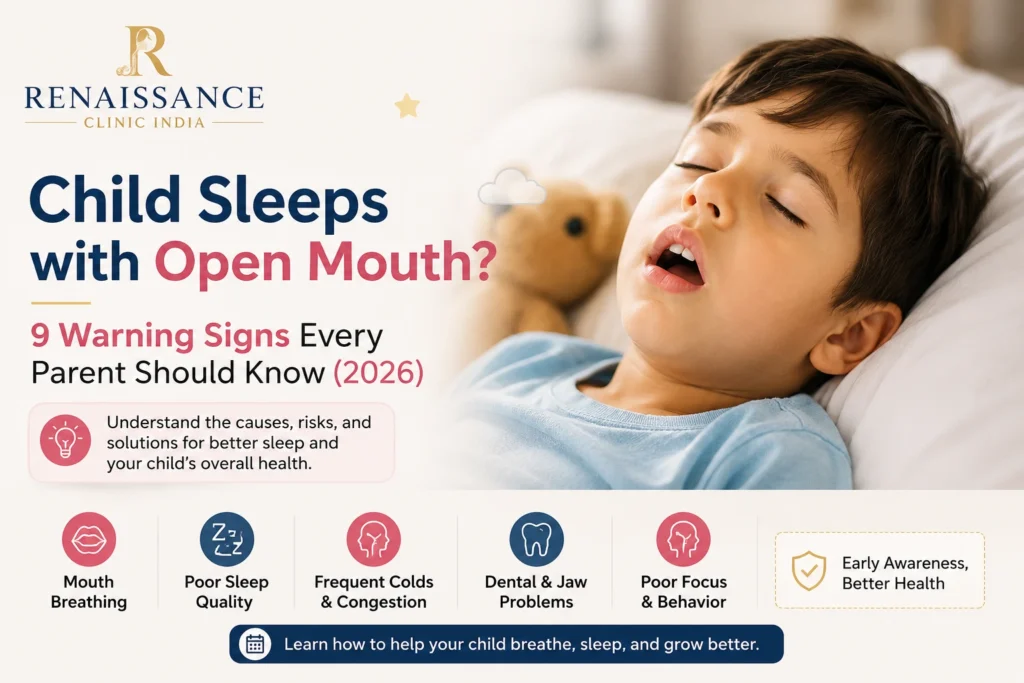
If your child sleeps with open mouth almost every night, it’s easy to brush it off as “just a habit.” Most parents do. But open-mouth sleeping is rarely random — it’s usually the body’s way of compensating for something blocking easy nasal airflow. Left unaddressed, it can quietly reshape your child’s jaw, teeth, sleep quality, and even daytime behaviour.
This guide breaks down exactly why children breathe through their mouth at night, the 9 warning signs every parent should watch for, and what to do next.
Table of Contents
- Why Does My Child Sleep with Open Mouth?
- 9 Warning Signs Every Parent Should Know
- Why This Matters for Dental Health
- When to See a Pediatric Dentist
- How We Help at Child Dentist Indirapuram
- FAQs
Why Does Your Child Sleeps with Open Mouth?
Normal, healthy breathing happens through the nose, with lips gently sealed and the tongue resting against the roof of the mouth. When a child consistently breathes through their mouth instead, it’s usually because the nasal airway is partially blocked. Common triggers include:
- Nasal congestion or seasonal allergies
- Enlarged tonsils or adenoids
- A deviated septum or naturally narrow nasal passage
- Chronic sinus issues
- Tongue-tie or lip-tie restricting normal tongue posture
Occasional mouth breathing during a cold isn’t a concern. But when it happens night after night, it becomes a habit that can affect your child’s growth and development in ways most parents never expect.
9 Warning Signs Every Parent Should Know
1. Open Mouth or Parted Lips During Sleep
The most obvious sign — you’ll notice your child’s mouth hanging open for most of the night, rather than lips gently closed.
2. Loud Breathing or Snoring
Noisy breathing, snoring, or audible gasping at night often signals restricted airflow through the nose.
3. Dry, Cracked Lips or Dry Mouth in the Morning
Because saliva isn’t washing over the teeth and gums all night, kids who sleep with open mouth often wake up with a parched mouth or dry, chapped lips.
4. Frequent Waking or Restless Sleep
Mouth breathers often shift positions, kick off blankets, or wake up more than usual, even if they don’t fully realise it.
5. Dark Circles or “Tired” Looking Eyes
Poor-quality, interrupted sleep frequently shows up as under-eye shadows, even in children who technically slept a full night.
6. Daytime Sleepiness, Irritability, or Trouble Focusing
Because open-mouth breathing disrupts deep, restorative sleep stages, children may seem cranky, hyperactive, or unable to concentrate at school — symptoms that are sometimes mistaken for behavioural issues.
7. Crowded or Crooked Teeth Developing Early
When the tongue doesn’t rest against the palate as it should, the upper jaw doesn’t widen properly. Over time this can lead to a narrow, high-arched palate and crowded teeth.
8. Visible Gum Irritation or Redness
Constant airflow across exposed gum tissue, especially near the front teeth, can leave gums looking dry, red, or swollen.
9. A “Long Face” or Recessed Chin Appearance
Chronic mouth breathers sometimes develop a subtly longer, narrower facial structure over the years, along with a receding chin — a pattern dentists often describe as “long face syndrome.”
Why This Matters for Dental Health
Mouth breathing isn’t just a nighttime nuisance — it directly affects how a child’s mouth and face develop. Research on dentofacial growth shows that normal nasal breathing is essential for balanced jaw and facial development, and children who habitually breathe through the mouth show noticeably higher rates of bite problems (also known as malocclusion) compared to nasal breathers. Without saliva regularly bathing the teeth and gums overnight, mouth-breathing children are also more prone to cavities, gum inflammation, and bad breath.
Because most craniofacial growth happens between birth and around age 12, catching and correcting mouth breathing early gives your child the best chance at healthy jaw development, straighter teeth, and better sleep — without needing more extensive orthodontic correction later.
When to See a Pediatric Dentist
Book an evaluation if you notice:
- Your child sleeps with open mouth most nights, not just during a cold
- Snoring or pauses in breathing during sleep
- Visible crowding, an overbite, or an open bite forming
- Persistent dry mouth, bad breath, or gum irritation
- Daytime fatigue, poor concentration, or mood changes
A pediatric dentist can check for early signs like dry gums, a narrow palate, or tongue posture issues, and coordinate with an ENT or paediatrician if the root cause is airway-related.
How We Help at Child Dentist Indirapuram
At Child Dentist Indirapuram, we look beyond just teeth — assessing airway health, jaw development, and oral posture as part of every child’s checkup. If your child shows any of the warning signs above, our team can identify the underlying cause and guide you toward the right next step, whether that’s a simple habit-correction plan, an ENT referral, or early orthodontic guidance to support healthy jaw growth.
Catching mouth breathing early is one of the simplest ways to protect your child’s smile — and their sleep — for years to come.
FAQs
Is it normal for a child to sleep with their mouth open sometimes?
Occasional open-mouth breathing during a cold or blocked nose is normal. It becomes a concern when it happens most nights over weeks or months.
Can mouth breathing be reversed in children?
Yes, especially when caught early. Treating the underlying cause (allergies, enlarged tonsils, tongue-tie, etc.) combined with myofunctional therapy or orthodontic guidance can often restore normal nasal breathing.
Does open-mouth sleeping affect a child’s teeth permanently? If left untreated through the growth years, it can contribute to lasting changes in jaw width, bite alignment, and facial structure — which is why early evaluation matters.
Should I see a dentist or a doctor first?
Either is a reasonable starting point. A pediatric dentist can spot oral and dental clues, and will refer you to an ENT or paediatrician if an airway obstruction needs to be ruled out.
If your child regularly sleeps with their mouth open, don’t wait for it to “grow out on its own.” Book a checkup with Child Dentist Indirapuram to catch the warning signs early.