
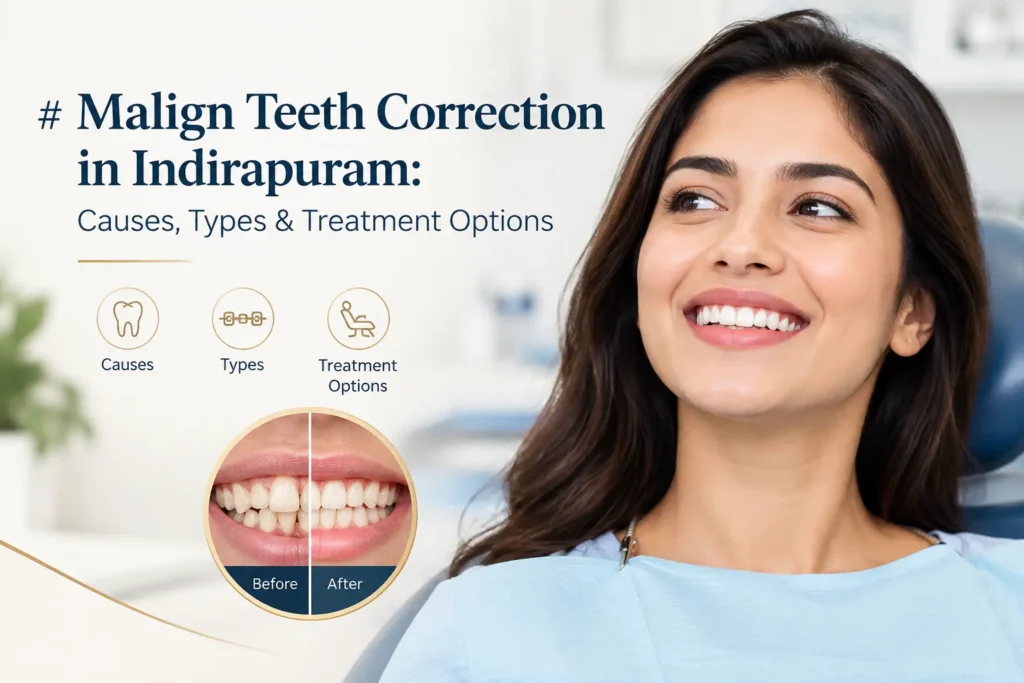
Searching for malign teeth correction in Indirapuram? You’re likely describing what dentists call malaligned teeth — teeth that don’t sit in their correct position relative to each other or the opposite jaw. It’s one of the most common reasons parents and adults visit us at Renaissance Dental Clinic, and it’s also one of the most treatable, at almost any age, once it’s properly diagnosed.
This guide explains what malaligned teeth actually are, why they happen, and the correction options available at our Indirapuram clinic.
In this guide:
- What Are Malaligned (“Malign”) Teeth?
- Types of Malocclusion We See
- What Causes Teeth to Become Malaligned?
- Why Correcting Malaligned Teeth Matters Beyond Appearance
- Malign Teeth Correction Options at Our Indirapuram Clinic
- Children vs. Adults: Does Age Change the Treatment?
- FAQs
What Are Malaligned (“Malign”) Teeth?
In dentistry, teeth that don’t line up correctly — whether that’s overlapping, tilted, rotated, gapped, or biting incorrectly against the opposite jaw — fall under malocclusion, from the Latin for “bad bite.” “Malaligned teeth” and “malign teeth” (the term many parents search) both describe the same thing: a bite or tooth position that isn’t functioning or fitting the way it should.
This is different from a single chipped or discoloured tooth — malalignment is about position and bite, not the health of the tooth surface itself, which is why correction usually involves guided tooth movement (braces, aligners, or appliances) rather than restorative work.
Types of Malocclusion We See
During a clinical exam, we typically classify malalignment into a few recognisable patterns:
- Crowding — teeth overlapping or twisting because there isn’t enough space in the jaw
- Spacing — visible gaps between teeth
- Overjet/Overbite — upper front teeth project too far forward or down over the lower teeth
- Underbite — lower teeth sit in front of the upper teeth when the mouth closes
- Crossbite — one or more upper teeth sit inside the lower teeth instead of outside
- Open bite — front teeth don’t touch when the back teeth are closed
- Rotated or displaced teeth — individual teeth angled or positioned out of the dental arch
Correction depends entirely on which pattern (often a combination) is present, which is why we don’t recommend any appliance without a proper bite assessment first.
What Causes Teeth to Become Malaligned?
Most cases we see trace back to one or more of these:
- Jaw-to-tooth size mismatch — a genetically small jaw with normal or large teeth leaves too little room, causing crowding
- Prolonged childhood habits — thumb-sucking, pacifier use past toddlerhood, or tongue-thrusting apply constant low-grade pressure that shifts developing teeth
- Early loss of baby teeth — neighbouring teeth drift into the gap, leaving no space for the permanent tooth
- Mouth breathing — alters resting tongue and jaw posture, which can narrow the upper arch over time
- Injury or trauma — a knocked or displaced tooth can shift its neighbours
- Untreated tooth loss in adults — missing back teeth in adulthood allow surrounding teeth to tilt and drift, sometimes years after the tooth was lost
Why Correcting Malaligned Teeth Matters Beyond Appearance
Malalignment isn’t only a cosmetic concern. Left uncorrected, it can contribute to:
- Uneven wear and jaw strain — a bite that doesn’t close evenly places extra force on certain teeth and the jaw joint
- Harder-to-clean surfaces — overlapping or rotated teeth trap plaque, increasing cavity and gum disease risk in exactly the spots that are hardest to brush and floss
- Speech and chewing difficulty — depending on the type of malocclusion, pronunciation and chewing efficiency can both be affected
- Compounding misalignment over time — malaligned teeth tend to drift further out of position as pressure and wear continue, so correction generally gets more involved the longer it’s delayed
Malign Teeth Correction Options at Our Indirapuram Clinic
Dr. Anamika Jain assesses the type, severity, and underlying cause of malalignment before recommending treatment — there’s no single fix that suits every bite. Depending on the case, correction may involve:
1. Braces
The most established way to correct crowding, rotated teeth, and bite discrepancies — a controlled, predictable option for moderate-to-severe malalignment. See our braces for kids page for the child-specific approach.
2. Clear Aligners
For mild-to-moderate malalignment, especially in older children, teens, and adults, clear aligners offer a removable, far less visible way to correct tooth position gradually.
3. Interceptive Appliances (for Children)
When malalignment is caught early — often during a routine pediatric dental consultation — simple appliances can guide jaw growth or hold space, sometimes reducing or removing the need for full braces later.
4. Habit Management
If a habit like thumb-sucking or mouth breathing is actively causing the malalignment, we address that alongside any appliance, otherwise teeth tend to relapse once treatment ends.
5. Retention
Once correction is complete, a retainer maintains the new position while surrounding bone and tissue stabilise.
Children vs. Adults: Does Age Change the Treatment?
Age changes the options, not whether correction is possible.
- In children, the jaw is still growing, so interceptive appliances can guide growth itself — often the most efficient window for correction.
- In teens and adults, growth has largely finished, so correction relies on moving teeth through existing bone using braces or aligners — very effective, but typically a longer, more mechanical process than early intervention would have been.
If you’re evaluating malign teeth correction for an adult in the family as well as a child, we assess both separately — the underlying cause and the treatment plan are rarely identical.
Frequently Asked Questions
What is “malign teeth correction”?
It refers to correcting malaligned teeth — teeth that overlap, tilt, gap, or bite incorrectly against the opposite jaw, medically termed malocclusion.
Can malaligned teeth be corrected without braces?
In select mild-to-moderate cases, yes — clear aligners or, in growing children, interceptive appliances can correct alignment without traditional braces. Severity determines what’s appropriate.
At what age should malaligned teeth be evaluated in children?
We recommend a first orthodontic screening by around age 7, when enough permanent teeth have typically erupted to assess developing bite problems, even if active treatment doesn’t start until later.
Is it too late to correct malaligned teeth as an adult?
No. Jaw growth is complete in adults, so correction takes longer and relies fully on braces or aligners moving teeth through bone, but it’s routinely successful at any age with healthy gums and teeth.
Does malocclusion always need treatment?
Not always — very mild misalignment with no functional or hygiene impact may just be monitored. A clinical assessment is the only reliable way to know whether treatment is advisable in your case.
Book a Malign Teeth Correction Consultation in Indirapuram
If you’ve noticed crowding, gaps, or a bite that doesn’t feel right for yourself or your child, an assessment is the first step to knowing what correction — if any — is needed. Book a consultation with Dr. Anamika Jain at Renaissance Dental Clinic, Indirapuram.
📍 64-66 LGF, Gate No. 2, Jaipuria Mall, Ahinsa Khand II, Indirapuram, Ghaziabad, U.P. 201014 📞 0120-4225557 Book an appointment