
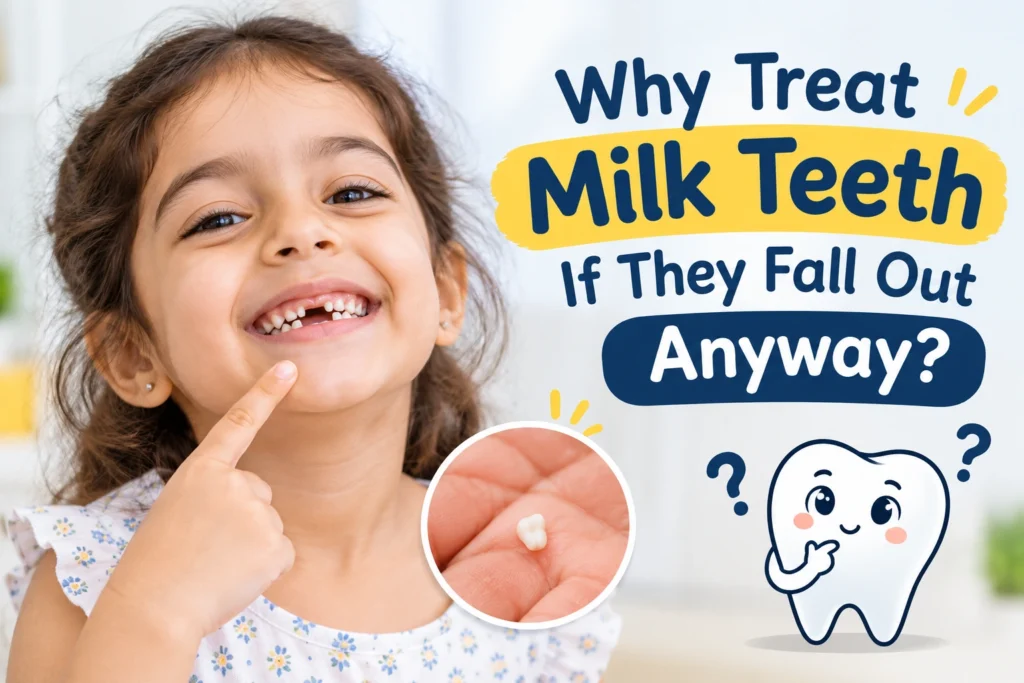
Why treat milk teeth? Because milk teeth (baby teeth) stay in your child’s mouth for 6 to 12 years, and during that time they help your child eat, speak and smile, and guide the adult teeth into the right place. A cavity or infection in a milk tooth can cause pain, swelling and even damage the permanent tooth growing underneath. Treating milk teeth protects your child’s health today and their smile tomorrow.
If you have ever heard “Why spend money on a tooth that will fall anyway?”, you are not alone. It is the question we hear most often from parents at our clinic in Indirapuram. Let’s answer it honestly, with no scary language and no unnecessary treatment.
Why Treat Milk Teeth When They Are Only Temporary?
The thinking sounds logical: temporary teeth, temporary problem. Many of us also grew up in homes where a childhood toothache was handled with clove oil and “it will go away when the tooth falls.”
The problem is the timeline. A child who gets a cavity at age 3 may still need that tooth until age 10 or 11. That is a very long time to live with a hole, a toothache or an infection.
Milk tooth | Usually falls out at |
|---|---|
Front teeth (incisors) | 6 to 8 years |
Canines (pointed teeth) | 9 to 12 years |
Back teeth (molars) | 10 to 12 years |
These are average ages. Every child is a little different.
The back molars are the teeth most prone to cavities, and they are also the ones that stay the longest. This is the first reason why milk teeth need treatment: they simply have a lot of work left to do.
6 Reasons Why Milk Teeth Treatment Matters
1. Healthy milk teeth help your child eat and grow well
A child with a painful cavity often avoids chewing on that side, eats less, or refuses harder foods like roti, apple or salad. Over time this can affect nutrition and energy. Healthy teeth make mealtimes easier for the whole family.
2. Milk teeth help with clear speech
Sounds like “s”, “t”, “d” and “th” need the front teeth to be in place. If a front tooth is lost too early to decay, speech development can be affected in some children.
3. Milk teeth keep space for adult teeth
This is the reason dentists care most about. Each milk tooth holds the space for the permanent tooth below it. If a milk tooth is lost too early because of decay, the neighbouring teeth can drift into the gap. The adult tooth then has less room and may come out crooked, crowded or stuck. This can lead to braces later that could have been avoided.
4. Infection in a baby tooth can reach the adult tooth
The roots of milk teeth sit very close to the permanent tooth buds. When decay reaches the nerve of a baby tooth, infection can form a pus pocket (abscess) at the root. In some children this can leave marks, spots or weak enamel on the permanent tooth that comes next. The gum may also swell, and in rare cases the infection can spread to the face.
5. Treating milk teeth prevents pain, bad sleep and missed school
A child with an untreated toothache is often cranky, sleeps badly and finds it hard to concentrate. Parents sometimes notice a sudden drop in appetite or school mood before they notice the cavity itself.
6. Early treatment builds a fear-free relationship with the dentist
When small cavities are ignored, treatment later becomes bigger, longer and more uncomfortable. A child who has a painful emergency visit is more likely to be afraid of dentists as an adult. A child who has a simple, gentle early filling usually learns that the dentist is a safe place.
Signs Your Child’s Milk Tooth Needs Treatment
See a pediatric dentist if you notice any of these:
- White, brown or black spots or lines on a tooth
- A visible hole or a tooth that looks dark
- Your child complains of pain, or avoids chewing on one side
- Sensitivity to cold, hot or sweet foods
- Swollen gums, a pimple-like bump on the gum, or bad breath that does not go away
- A tooth that was hit in a fall or injury
- Food getting stuck between teeth again and again
Many early cavities cause no pain at all. That is why a check-up every six months is better than waiting for a complaint.
How Are Milk Teeth Treated?
The treatment depends on how deep the problem is. A pediatric dentist always tries to choose the simplest option that works.
- Fluoride and preventive care: For very early decay (white spots), fluoride application and better brushing can sometimes stop or reverse the damage. Read more about fluoride treatment for kids.
- Sealants: A thin protective coating on the grooves of back teeth, with no drilling and no injection. See dental sealants for children.
- Tooth-coloured fillings: For small to medium cavities. Learn about teeth filling for children.
- Pulp therapy (child root canal): When decay has reached the nerve, the infected part is cleaned and the tooth is saved. This is gentler than it sounds. See root canal treatment for children.
- Dental crowns: For teeth with large cavities or weak structure, a crown protects the tooth until it falls naturally. Read about dental crowns for children.
- Extraction: Only when a tooth cannot be saved, or is badly infected. In that case, a space maintainer may be placed to hold room for the adult tooth. Details on baby tooth extraction in Indirapuram.
Why Not Just Wait for the Milk Tooth to Fall Out?
Sometimes waiting is fine, and we believe in being honest about this. Not every milk tooth needs a procedure.
- A tooth that is already loose and close to falling out is usually left to fall naturally.
- Very early white spot lesions may only need fluoride, diet changes and monitoring.
- A small chip on a front tooth that is not painful may just be watched.
But a dentist should decide this after examining your child, not guesswork at home. A tooth that looks “almost ready to fall” can still hide an infection beneath it.
Common Myths About Treating Milk Teeth
Myth | Fact |
|---|---|
“They will fall anyway, so there’s no need to treat them.” | Many stay until age 10 to 12, and infection can affect adult teeth. |
“If it doesn’t hurt, there’s no problem.” | Early cavities and even abscesses can be painless. |
“Baby tooth extraction is always better than a filling.” | Early loss can cause crowding. Saving the tooth is usually better. |
“Brushing isn’t needed until all teeth come out.” | Brushing should start as soon as the first tooth appears. |
“Children’s root canal is too painful.” | With child-friendly techniques and proper pain control, it is well tolerated. |
How to Protect Your Child’s Milk Teeth at Home
- Start early. Clean your baby’s gums with a soft cloth, and begin brushing when the first tooth erupts.
- Brush twice a day with a soft brush and a smear (rice-grain size) of fluoride toothpaste for children under 3, and a pea-sized amount for ages 3 to 6. Help your child brush until about age 7 or 8.
- Stop the bottle at night. Milk or juice left on the teeth during sleep is a major cause of early cavities.
- Limit sticky and sugary snacks. Toffees, chocolates, biscuits and packaged juices stay on the teeth. Keep sweets to mealtimes rather than constant snacking.
- Rinse with water after sweets or snacks if brushing is not possible.
- Book the first visit by age 1 or within six months of the first tooth appearing. After that, visit every six months.
Milk Teeth Treatment at Our Pediatric Dental Clinic in Indirapuram
At Child Dentist Indirapuram, our focus is to make dental visits calm and child-friendly. Dr. Anamika Jain completed her dental post-graduation from King George’s Medical University (KGMC), Lucknow, and has worked at Ram Manohar Lohia Hospital, New Delhi. Our approach includes:
- Gentle “Tell-Show-Do” communication so your child knows what is happening
- A thorough examination with clear explanation to parents before any treatment
- Preventive care first, and treatment only where it is needed
- Sedation options such as laughing gas for anxious children, when clinically appropriate
- Care for emergencies like toothache, swelling and dental injuries
We see families from Indirapuram, Vaishali, Vasundhara, Ghaziabad and Noida. Not sure whether your child’s tooth needs treatment? A simple pediatric dental consultation can give you a clear answer.
Frequently Asked Questions
Why is it important to treat milk teeth?
Milk teeth stay for 6 to 12 years and help with chewing, speech and holding space for permanent teeth. Treating decay early prevents pain, infection and problems with the adult teeth.
Should I get a cavity in my child’s milk tooth filled?
In most cases, yes. A cavity does not heal on its own and usually gets bigger with time. Filling it early is simpler, quicker and more comfortable than waiting for pain or infection.
What happens if a milk tooth cavity is not treated?
It can lead to toothache, swelling, abscess, difficulty eating and, in some cases, damage to the developing permanent tooth. It can also cause early tooth loss, which affects spacing for adult teeth.
Is root canal treatment necessary for milk teeth?
It is needed when decay or injury reaches the nerve of a baby tooth. Pulp therapy lets us save the tooth so it can continue to do its job until it falls out naturally.
Can a baby tooth be pulled out instead of being treated?
Sometimes extraction is the best option, especially if the tooth is badly infected or close to falling. But removing a tooth too early can cause crowding, so your dentist may suggest a space maintainer.
At what age should my child first see a dentist?
By the first birthday, or within six months after the first tooth appears.
How often should children visit the dentist?
Usually every six months. Children who get cavities easily may need more frequent visits.
The Bottom Line: Why Treat Milk Teeth?
Milk teeth are temporary, but their effect on your child’s health, speech, confidence and future adult teeth is not. Treating them early means fewer problems, less pain and a happier dental journey for your child.
If you have noticed a spot, a hole or any discomfort in your child’s tooth, do not wait for it to fall out.
Book a visit with Dr. Anamika Jain at Child Dentist Indirapuram.
Address: 64-66 LGF, Gate No. 2, Jaipuria Mall, Ahinsa Khand II, Indirapuram, Ghaziabad, Uttar Pradesh 201014 Phone: 0120-4225557 Timings: Monday to Friday 10:00 AM to 8:00 PM | Sunday on appointment Website: childdentistindirapuram.com
This article is for general education and does not replace a dental examination. Every child is different, so please consult a pediatric dentist for advice about your child.