
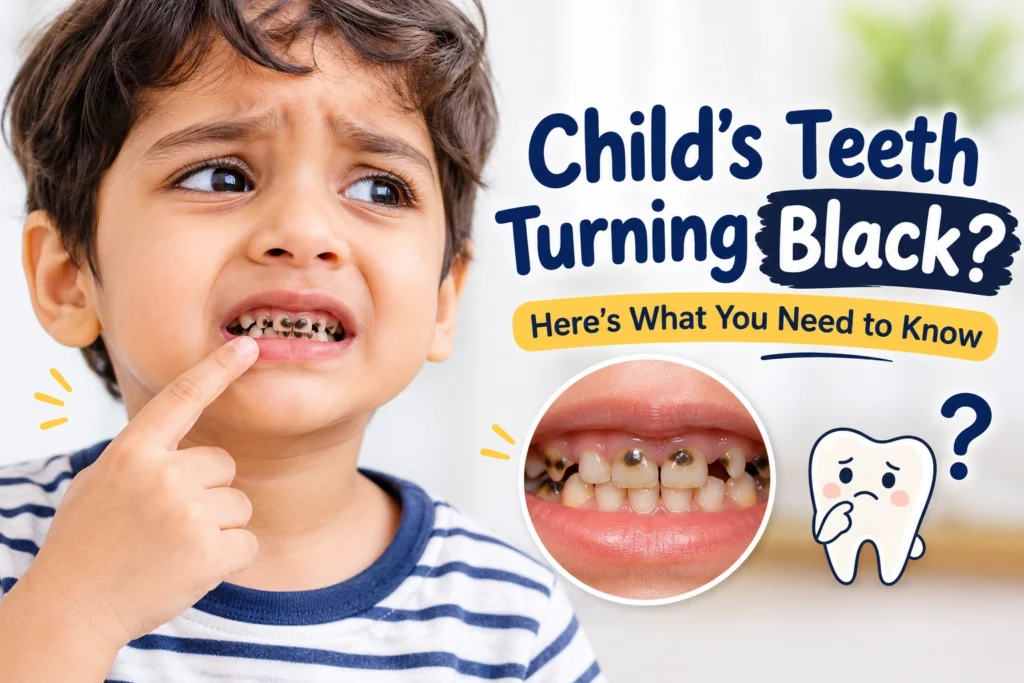
You brush your little one’s teeth one evening and notice a dark spot, a grey tooth, or a black line near the gums. It is natural to feel worried. The good news: black teeth in children are common, and most causes are treatable, especially when caught early. This guide explains why your child’s teeth may be turning black, which causes are harmless, and which ones need a pediatric dentist right away.
Quick Answer
The most common reason a child’s tooth turns black is tooth decay (a cavity). Other causes include iron supplements, bacterial stains, an injury that damaged the tooth’s nerve, and some medicines. Surface stains can be polished off, but decay and injured teeth need treatment. Book a dental check-up soon, and go the same day if your child has swelling, fever, pain, or a pimple-like bump on the gum.
Common Causes of Black Teeth in Children
1. Tooth Decay (Cavities)
Cavities are the number one cause. Early decay first appears as a chalky white patch, then turns brown, and finally black as the enamel breaks down. Sugary snacks, chocolates, sticky biscuits, juices, and sipping milk or sweet drinks through the day all feed the bacteria that cause decay. Cavities often start in the grooves of back teeth or between teeth, so you may notice only a small dark dot at first.
2. Baby Bottle Tooth Decay (Early Childhood Caries)
Toddlers who fall asleep with a feeding bottle, or who breastfeed or bottle-feed frequently at night without teeth being cleaned, can develop decay on the upper front teeth. These teeth may turn brown or black near the gum line and can break down quickly. This pattern is called early childhood caries, and it is one of the most common reasons parents bring toddlers to a child dentist.
3. Iron Supplements and Syrups
Liquid iron tonics prescribed for anaemia can leave black or dark grey stains on the teeth. These are surface stains, not decay. They usually appear as a thin dark layer on the inside or outside of the teeth and can be professionally polished off. Never stop an iron supplement on your own. Ask your doctor or dentist how to limit staining, for example by giving the syrup with a straw and rinsing the mouth afterwards.
4. Black Bacterial Stain (Chromogenic Bacteria)
Some children develop a thin black or dark-green line along the gum line, or small black dots on the teeth, caused by certain harmless bacteria. This stain is not a cavity, tends to come back after cleaning, and is seen even in children who brush well. A pediatric dentist can remove it with gentle polishing and guide you on keeping it from returning.
5. Injury or a “Dead” Tooth
A fall, a knock against furniture, or a sports injury can damage the nerve (pulp) inside a tooth. Over days to weeks, the tooth may turn grey, brown, or black, even if it did not hurt much at the time. A darkened tooth after trauma can mean the nerve has died and may lead to infection. Do not wait for it to fall out. A dental examination, and sometimes an X-ray, is needed to decide on treatment.
6. Medicines, Foods and Mouthwashes
Dark foods and drinks, some liquid medicines, and certain prescription mouth rinses can cause brown to black surface stains. These usually polish off. Staining that affects many teeth evenly and is present from when the teeth first appeared is a different problem and should be evaluated by a dentist.
7. A Cavity Treated with Silver Diamine Fluoride (SDF)
Some pediatric dentists use silver diamine fluoride to stop cavities from spreading, particularly in very young or anxious children. The treated area turns black by design. If your child recently had this treatment, the darkening is expected. Ask your dentist whether this treatment suits your child.
Black Teeth in Kids: Cause Comparison at a Glance
| Cause | What It Looks Like | How Serious? | Typical Solution |
|---|---|---|---|
| Cavity (decay) | Brown or black spot, pit or hole, may feel sticky | Moderate to high; worsens over time | Filling, pulp therapy or crown |
| Bottle decay | Dark bands near gums on front teeth | High; spreads fast | Urgent dental care, crowns, diet and feeding changes |
| Iron syrup stain | Thin black or grey surface layer | Low; cosmetic | Professional polishing; preventive tips |
| Bacterial stain | Black line or dots at the gum line | Low; harmless | Scaling and polishing |
| Injury (non-vital tooth) | Single grey, brown or black tooth after a knock | Moderate to high; infection risk | X-ray, monitoring or pulp treatment |
| SDF-treated cavity | Black, hard, painless area | Expected result of treatment | Follow-up visits; restoration later if needed |
How to Tell a Stain from a Cavity (Parent Checklist)
Only a dentist can diagnose the cause, but these clues help you describe the problem:
- More likely a stain: flat and smooth, often along the gum line or on many teeth, no pain, no hole, and it may look better after a good brushing or professional polish.
- More likely a cavity: a dark pit, hole or rough patch, food getting stuck, bad breath, sensitivity to sweets, cold or hot, or pain when chewing.
- More likely an injured tooth: only one tooth has changed colour and there is a history of a fall or knock.
A black tooth in a child should always be checked, even if it looks painless. Early decay can be treated with a simple filling, while delay may mean root canal-type treatment or extraction.
When Should You See a Child Dentist Immediately?
Seek a pediatric dental appointment the same day if your child has any of these along with a black tooth:
- Swelling of the gum, cheek or face
- A pimple-like bump (abscess) on the gum
- Fever or a general unwell feeling
- Pain that wakes your child at night or stops them eating
- A tooth that darkened after a fall or injury
- Bad taste or pus in the mouth
These can be signs of infection, which can spread beyond the tooth. Learn more about our pediatric dental emergency care, or call us on 0120-4225557.
How Do Pediatric Dentists Treat Black Teeth?
Treatment depends on the cause and your child’s age:
- Cleaning and polishing: for surface stains from iron, food or bacteria.
- Fluoride treatment: to strengthen enamel and reverse very early decay. See our fluoride treatment for kids.
- Tooth-coloured fillings: to repair small to medium cavities. Read about teeth fillings for children.
- Pulp therapy (child root canal): when decay or injury has reached the nerve but the tooth can be saved. See root canal treatment for children.
- Dental crowns: to protect heavily decayed baby or permanent teeth. See dental crowns for children.
- Extraction: when a baby tooth cannot be saved. A space maintainer may be advised to protect room for the adult tooth. See baby tooth extraction.
- Sedation options: for very young or anxious children who need longer treatment, when clinically appropriate. See sedation dentistry for kids.
“But They’re Only Baby Teeth, Do They Really Need Treatment?”
Yes. Baby teeth help your child chew, speak clearly, and hold space for permanent teeth. Some baby molars stay until age 10 to 12. An untreated black, decayed baby tooth can cause pain, infection, difficulty eating, and may affect the permanent tooth growing beneath it. Treating it early is simpler, cheaper and far less stressful for your child.
How to Prevent Black Teeth in Children
- Brush twice a day with fluoride toothpaste: a smear about the size of a grain of rice for children under 3, and a pea-sized amount for ages 3 to 6. Supervise brushing until about age 7 to 8.
- Clean at bedtime, always. Do not let your child fall asleep with a bottle of milk, juice or sweet drinks.
- Limit sticky and sugary snacks and keep them to mealtimes instead of grazing all day.
- Rinse with water after iron syrups or sweet medicines, and brush later if the doctor allows.
- Start dental visits by the first birthday and then check-ups roughly every six months, or as advised.
- Ask about sealants: a painless way to protect deep grooves of back teeth. See dental sealants for children.
- Use a mouthguard for contact sports and keep floors and play areas safe for toddlers.
What Not to Do If Your Child’s Tooth Is Turning Black
- Don’t scrub the tooth hard or use baking soda, charcoal, lemon or whitening products. They can damage enamel and will not fix decay.
- Don’t ignore it because “it will fall out anyway.”
- Don’t apply home remedies like clove oil paste or aspirin on the gum for pain. They can burn the tissue.
- Don’t delay if there is swelling or fever.
Child Dentist in Indirapuram for Black or Discoloured Teeth
At Renaissance Child Dental Centre, Dr. Anamika Jain is a postgraduate-trained pediatric dentist, a gold medalist from King George’s Medical University (KGMU), Lucknow, with hospital experience at Ram Manohar Lohia Hospital, New Delhi. Our clinic is designed to keep children relaxed, using child-friendly communication and gentle techniques. Families visit us from Indirapuram, Vaishali, Vasundhara, Ghaziabad, Noida and across Delhi NCR.
Whether it is a small dark spot or a fully black tooth, we will find the cause, explain it in simple words, and recommend the least invasive treatment that works. Explore our pediatric dental consultation and prevention programme to get started.
Book Your Child’s Dental Check-Up
Child Dentist Indirapuram (Renaissance Child Dental Centre)
64–66 LGF, Gate No. 2, Jaipuria Mall, Ahinsa Khand II, Indirapuram, Ghaziabad, Uttar Pradesh 201014
Phone: 0120-4225557
Email: info@renaissanceclinicindia.com
Frequently Asked Questions About Black Teeth in Children
Why is my child’s front tooth turning black?
The most likely causes are an injury that damaged the nerve, or decay on the upper front teeth, often linked to night-time bottle feeding. Either one needs a prompt dental check-up to prevent infection.
Can black stains on children’s teeth be removed?
Surface stains from iron syrup, foods or bacteria can usually be removed by professional cleaning and polishing. Black areas caused by decay cannot be polished away and need a filling or other treatment.
Are black spots on baby teeth always cavities?
No. They may be cavities, stains from iron or bacteria, or the result of an injury. A pediatric dentist can tell them apart with an examination and, when needed, an X-ray.
Will my child’s black tooth fall out on its own?
A baby tooth will eventually fall out, but waiting is risky. A decayed or infected tooth can cause pain, swelling and damage to the permanent tooth underneath, and it may stay in the mouth for years.
Is a black tooth painful for kids?
Not always. Many children with black teeth have no pain until the decay is deep or an infection develops. Lack of pain does not mean it is safe to wait.
Can iron drops make my baby’s teeth black?
Yes, they can cause dark surface stains. These are generally harmless and removable by a dentist. Continue the iron as prescribed and talk to your doctor and dentist about preventing stains.
At what age should I take my child to a dentist?
By the first birthday, or within six months of the first tooth appearing. Early visits help catch problems such as early decay before they turn into black, painful cavities.
About the author: Dr. Anamika Jain is a pediatric dentist in Indirapuram, Ghaziabad. She completed her postgraduate dental degree at King George’s Medical University (KGMU), Lucknow, where she was a gold medalist, and previously worked at Ram Manohar Lohia Hospital, New Delhi.