
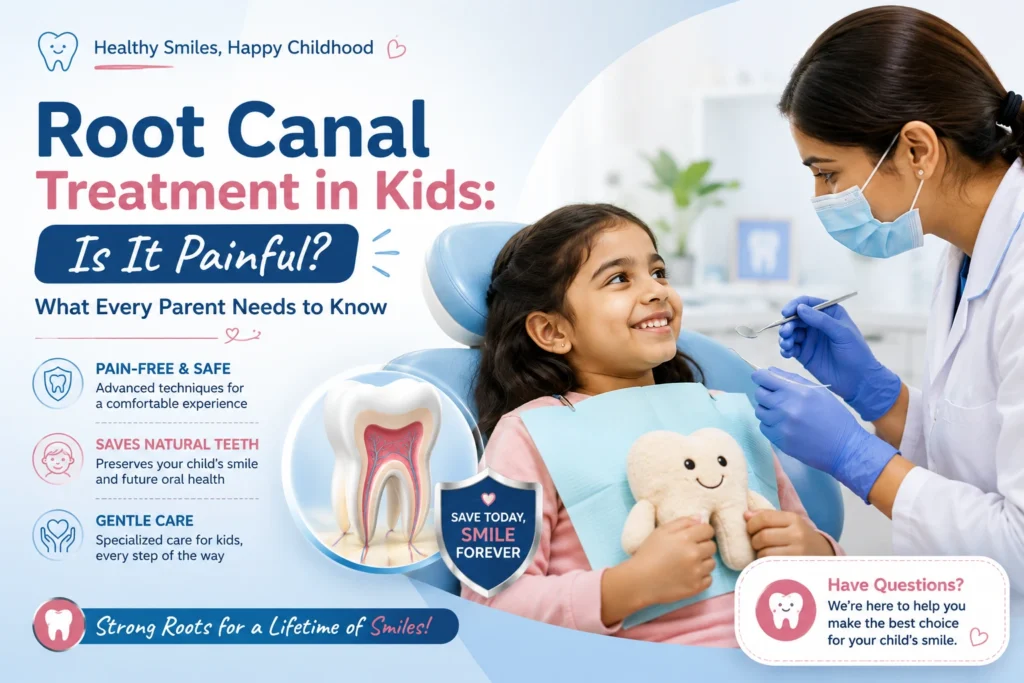
“Doctor, will it hurt her?”
That’s usually the first thing a parent asks me the moment I mention root canal treatment in kids. I’ve heard it hundreds of times in my years of practice, and I understand exactly why — the words “root canal” alone make most grown-ups wince, so it’s only natural to worry about how a young child will cope.
I’m Dr. Anamika Jain, a pediatric dental specialist at Renaissance Dental Clinic in Indirapuram, Ghaziabad. Over the years — treating children from Indirapuram, Vaishali, Vasundhara, Noida and across Delhi NCR — I’ve performed this procedure on kids as young as three, and I can tell you honestly: a root canal is meant to take pain away, not add to it. In this article I want to walk you through exactly what happens, how much discomfort to genuinely expect, and when I’d recommend extraction instead.
What Is Root Canal Treatment in Kids, Exactly?
When a baby (milk) tooth’s decay reaches the soft inner tissue — what we call the pulp — bacteria can infect the nerve and blood supply living inside the tooth. Left alone, this infection causes swelling, painful abscesses, and can even damage the permanent tooth quietly forming underneath.
Depending on how deep the infection has gone, I use one of two closely related procedures, both loosely called a “kids’ root canal”:
- Pulpotomy – I remove only the infected top portion of the pulp and leave the healthy root portion in place, protected with a medicated dressing. This is what I use most often for baby molars.
- Pulpectomy – Reserved for cases where infection has spread through the entire root canal system. I remove the full pulp, clean out the canals, and fill them with a special material that resorbs naturally as the tooth prepares to fall out on its own.
You can read more about how we perform both procedures at our clinic on our root canal treatment for children page.
So, Is Root Canal Treatment Painful for Kids?
This is really the heart of what every parent wants answered, so let me be direct about it.
In my experience, a properly performed root canal is no more painful than a routine filling — often less, because the child usually walks in already in pain from the infection. Here’s what actually happens in my chair:
- I numb the area completely with local anesthesia before touching the tooth, so the child feels no pain during the procedure itself.
- The infected nerve is usually the actual source of their toothache — once I’ve treated it, most of my little patients feel relief within the same visit, not new pain.
- The appointment itself is quick. A pulpotomy on a single tooth typically takes me 20–30 minutes, chair-side.
- I’m trained specifically in managing anxious children — using distraction, gentle explanation in language kids understand, and where truly needed, mild sedation like nitrous oxide (laughing gas) to keep even the most nervous child calm and cooperative.
It’s completely normal for the gum to feel a little tender for a day or two afterward — much like an adult after a filling. I usually recommend an age-appropriate dose of paracetamol if needed, and this tenderness fades within 24–48 hours in almost every case I’ve treated.
For children who get particularly anxious at the mention of the dentist, I often suggest we discuss our sedation dentistry / laughing gas option beforehand, so you know exactly what to expect too.
Why Might Your Child Need a Root Canal?
A lot of parents tell me they assumed baby teeth “don’t really matter” since they’ll fall out eventually. I hear this often, and I always gently correct it — baby teeth:
- Hold space for the permanent teeth growing underneath and guide them into the right position
- Are essential for chewing, clear speech, and healthy facial development
- Can pass infection straight down to the permanent tooth bud if decay is ignored
In my clinic, the most common reasons I end up recommending a root canal for a child are:
- Deep, untreated cavities that have reached the nerve
- A fall or sports injury that’s cracked or chipped a tooth
- Prolonged bottle feeding at night or frequent sugary snacking, which I still see very often in toddlers
Root Canal vs. Extraction: What Would I Recommend for Your Child?
I get asked this constantly — “Why not just pull it out, Doctor?” In the vast majority of cases I see, saving the tooth is the better call, unless it’s already close to falling out on its own.
| Factor | Root Canal (Pulpotomy/Pulpectomy) | Extraction |
|---|---|---|
| Space maintenance for permanent teeth | Yes — natural spacer preserved | Needs a separate space maintainer appliance |
| Chewing & speech function | Preserved immediately | Temporarily affected |
| Emotional impact on the child | Minimal — tooth stays in place | Child notices a visible gap |
| Chair-side time | 20–40 minutes | 10–15 minutes |
| Long-term cost to you | One-time treatment + crown | Treatment + future space maintainer + monitoring visits |
| When I’d actually recommend it | Tooth has years left before natural exfoliation | Tooth is already loose or close to falling out |
As a rule I follow in my own practice: if the tooth has good bone support underneath and isn’t due to fall out soon, I’ll always try to save it first.
What Actually Happens During the Procedure, Step by Step
- Examination & X-ray – I check exactly how far the infection has spread and how the root looks
- Local anesthesia – I numb the tooth and surrounding gum completely
- Isolation – I place a rubber dam so the tooth stays dry and your child stays comfortable
- Pulp removal – I gently remove the infected tissue (pulpotomy or pulpectomy, depending on severity)
- Disinfection & filling – I clean the space and fill it with a child-safe, resorbable material
- Crown placement – I usually fit a stainless steel or tooth-colored crown afterward to protect the tooth long-term — you can see our options on the dental crowns for children page
My Aftercare Advice for Parents
- Avoid hard, sticky, or very hot foods for the first 24 hours
- Let your child brush gently around the treated tooth — don’t skip brushing altogether
- Call me if you notice swelling, fever, or pain lasting beyond 2–3 days — that’s not typical and I’d want to see your child again
- Keep up with routine 6-monthly checkups so I can monitor healing and the crown
If your child ever has sudden pain, swelling, or a knocked-out tooth outside our regular hours, our pediatric dental emergency care line is there for exactly that.
Frequently Asked Questions I Get From Parents
Is it normal for kids to get root canals?
Yes, completely. In my day-to-day practice, root canal treatment (pulpotomy or pulpectomy) is one of the most routine procedures I perform — whenever decay or trauma reaches the nerve of a baby tooth. It’s far more common than most parents expect before their first visit with me.
Is root canal treatment painful for kids?
No. I perform the procedure under local anesthesia, so your child won’t feel pain during treatment itself. Mild tenderness for a day or two afterward is normal and easily managed with age-appropriate pain relief.
What is the minimum age to get a root canal?
There’s no fixed minimum age in my practice — I’ve treated children as young as 2–3 years old with deep decay or nerve infection, though I see it most commonly in the 4–9 age group.
Is it better to do a root canal or extraction for kids?
In most cases I handle, saving the tooth is my preference, since baby teeth act as natural space-holders for the permanent teeth coming later. I only recommend extraction when the tooth is severely damaged, has poor bone support, or is already close to falling out on its own.
Is a root canal safe for a 7-year-old child?
Yes, very much so. I’d consider age 6–8 one of the most common windows I see for this treatment, since permanent teeth are often still developing underneath the baby molars at that age. With the right anesthesia and a gentle approach, it’s a safe, routine procedure.
What is the disadvantage of a root canal?
Honestly, the main downsides I mention to parents are that it may need more than one visit in complex cases, the tooth needs a protective crown afterward, and there’s a small chance of reinfection if underlying decay isn’t fully caught. In my experience, though, these risks are far smaller than the risks of leaving an infected tooth untreated.
A Personal Note From Dr. Anamika Jain
I trained at King George’s Medical University, Lucknow, as a gold medalist, and spent time at Ram Manohar Lohia Hospital in Delhi before opening Renaissance Dental Clinic as a certified Child Dental Centre here in Indirapuram. I say this not to list credentials, but because I want you to know that every recommendation in this article — and every one I make in my chair — comes from years of specifically treating children, not adults with smaller mouths. Your child’s comfort and long-term smile matter to me personally, and that’s exactly why I don’t take the decision between a root canal and extraction lightly.
If your child is in pain right now, please don’t wait it out hoping it goes away. Untreated infection almost always gets worse, and can affect the permanent tooth waiting underneath. Let’s take a look together.
📍 64-66 LGF, Gate No-2, Jaipuria Mall, Ahinsa Khand II, Indirapuram, Ghaziabad, U.P. 201014 📞 0120-4225557 📧 info@renaissanceclinicindia.com 🔗 Book an appointment with Dr. Anamika Jain