
Introduction
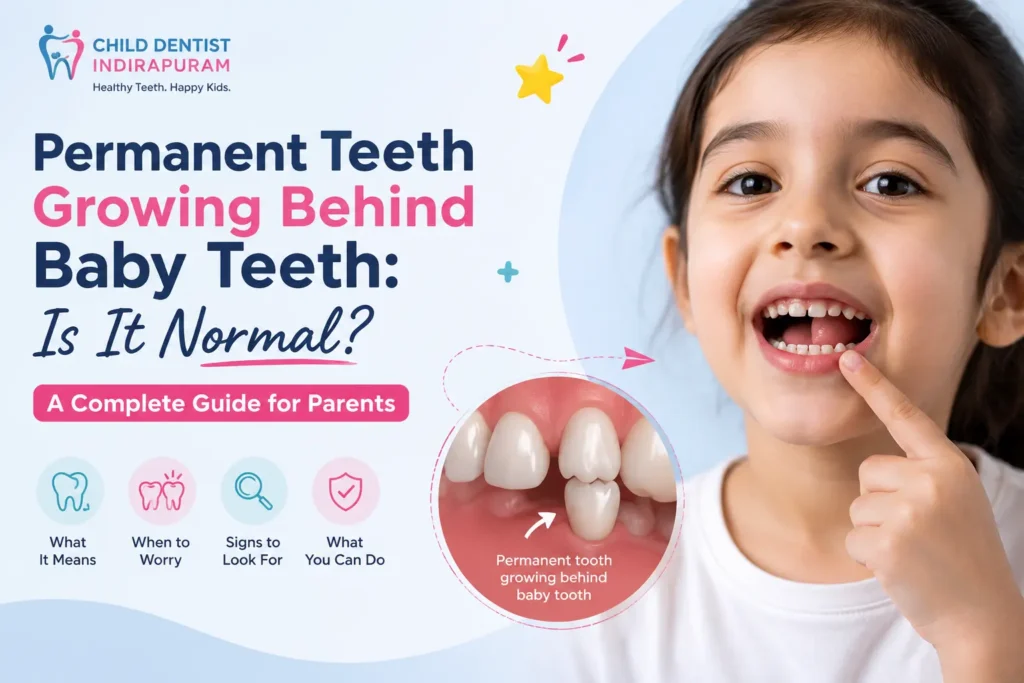
Permanent teeth growing behind baby teeth is a sight that stops most parents mid-scroll — one day you glance into your child’s mouth and spot a small white tooth poking up behind their baby tooth. Don’t panic — you’re not alone. This is one of the most common concerns parents bring to a pediatric dentist, and it even has a nickname: “shark teeth.”
While it can look alarming, in most cases this is a completely normal part of your child’s dental development. In this guide, we’ll explain exactly why it happens, when it resolves on its own, and when you should book a visit with Child Dentist Indirapuram to have it checked. This is closely related to a stage we cover in our article on thumb sucking in children, since both are common concerns during the mixed-dentition years.
What Are “Shark Teeth” and Why Do They Happen?
Just like sharks, who grow new rows of teeth behind old ones, some children develop their permanent teeth behind their baby (milk) teeth instead of directly underneath them.
This usually happens because of one simple reason: the roots of the baby tooth haven’t fully dissolved (resorbed) yet.
Normally, as a permanent tooth pushes up from below, it slowly dissolves the root of the baby tooth above it, causing the baby tooth to loosen and fall out — making room for the permanent tooth to erupt in the same spot.
But sometimes, the permanent tooth’s growth path shifts slightly, and it erupts from behind the baby tooth instead of directly beneath it. When this happens, you’ll see two rows of teeth for a short period — the baby tooth still in place, and the permanent tooth peeking out just behind it.
Where Does This Most Commonly Happen?
- Lower front teeth (incisors) — by far the most common location
- Occasionally in the upper front teeth
- Rarely in molars
Is It Normal? The Short Answer: Usually, Yes
For most children between the ages of 5 and 7 years, this is a normal — even expected — stage of mixed dentition (the phase where baby and permanent teeth coexist). According to the American Academy of Pediatric Dentistry (AAPD), the eruption of permanent teeth before baby teeth have shed is a recognized and common occurrence during this transitional stage, and is generally not a cause for concern on its own.
Here’s why it’s usually not a cause for alarm:
- The tongue naturally pushes the tooth forward. As your child talks, eats, and swallows, tongue pressure gradually pushes the new permanent tooth into its correct position.
- The loose baby tooth falls out on its own. Once the baby tooth’s root has resorbed enough, natural chewing pressure causes it to become wiggly and fall out within a few weeks to a couple of months.
- Self-correction happens in most cases. Studies and clinical experience show that in the majority of children, the permanent tooth aligns itself into the proper position once the baby tooth is gone.
When Should You Worry? Signs You Need a Dentist Visit
While shark teeth are usually harmless, there are situations where professional intervention is recommended:
- The baby tooth is not loose at all, even after several weeks
- More than 2-3 months have passed with no sign of the baby tooth loosening
- Your child complains of pain, discomfort, or difficulty chewing
- You notice crowding, or the permanent tooth appears to be erupting at a sharp angle
- Multiple teeth are affected at once
- Your child is younger than 5 and this is happening unusually early
- There’s swelling, bleeding, or infection around the area
If any of these apply, it’s best to schedule an evaluation rather than wait it out. If pain or swelling is involved, this can sometimes overlap with the warning signs described in our post on child tooth pain: 15 common causes.
What Happens If the Baby Tooth Doesn’t Fall Out on Its Own?
If the baby tooth is stubbornly holding on and blocking the permanent tooth from moving into its proper position, a pediatric dentist may recommend:
1. Simple Baby Tooth Extraction
A quick, gentle, and often painless procedure to remove the retained baby tooth. This gives the permanent tooth room to be guided into place by natural tongue and cheek pressure.
2. Monitoring with Follow-Up Visits
In borderline cases, your dentist may suggest observing for a few more weeks with a scheduled follow-up rather than immediate extraction.
3. Space Maintainers or Orthodontic Evaluation
If crowding is significant or the jaw doesn’t have enough space, your dentist may refer your child for an early orthodontic consultation to prevent future alignment issues.
Can This Be Prevented?
Shark teeth can’t really be “prevented” since it’s largely determined by genetics and the natural pattern of tooth eruption. However, you can reduce complications by:
- Encouraging your child to wiggle the loose baby tooth gently with clean hands or their tongue
- Avoiding overly hard or sticky foods that could cause discomfort near the area
- Maintaining regular 6-month dental checkups so any delay in shedding is caught early — read why we recommend summer holidays as an ideal time for a checkup
- Not pulling the tooth forcefully at home — improper extraction can cause pain, bleeding, or root fragments left behind
Frequently Asked Questions (FAQs)
Q1. At what age do kids usually get shark teeth? Most commonly between 5 to 7 years old, when the lower front permanent incisors begin to erupt.
Q2. Will the permanent tooth straighten out on its own? In most cases, yes — once the baby tooth falls out, tongue and lip pressure typically guides the permanent tooth into a normal position within a few months.
Q3. Does removing the baby tooth hurt? Since the baby tooth’s root has usually already resorbed significantly, extraction is typically quick and far less uncomfortable than parents expect. Local anesthesia is used if needed.
Q4. What if two permanent teeth are growing behind two baby teeth at once? This is still fairly common, especially with the four lower front teeth erupting around the same age. A dental checkup can confirm whether intervention is needed for one or both.
Q5. Should I be worried about crooked teeth later? A single episode of shark teeth rarely causes lasting crowding or misalignment. However, if you notice significant crowding, it’s worth an early orthodontic opinion around age 7 — this matches the American Dental Association’s general guidance that most children benefit from their first orthodontic screening around this age.
When to See a Pediatric Dentist in Indirapuram
Every child’s mouth develops a little differently, and a quick in-person check is the safest way to know whether your child’s case will resolve naturally or needs a simple procedure.
At Child Dentist Indirapuram, we specialize in gentle, child-friendly dental care and see this exact situation regularly in kids across Indirapuram, Vaishali, Vasundhara, and greater Ghaziabad. Our approach focuses on:
- Painless, stress-free extractions for children
- Clear guidance on whether to wait or intervene
- Regular growth and eruption monitoring for growing kids
- A calm, child-friendly clinic environment that keeps young patients relaxed
Book a Checkup Today
If you’ve noticed your child’s permanent tooth growing in behind their baby tooth, don’t wait and worry — get it checked by an expert.
📞 Call us now at 0120-4225557 to book an appointment with Child Dentist Indirapuram. 🌐 Visit childdentistindirapuram.com to learn more about our pediatric dental services.
A five-minute checkup today can save your child from discomfort — and give you peace of mind.
Related Articles You Might Like
- Thumb Sucking in Children: Causes, Side Effects & How to Stop It
- 15 Signs Your Child Has a Cavity (With Pictures)
- Child Tooth Pain: 15 Common Causes Every Parent Should Know
- How to Prepare Child for Dentist: 7 Simple Tips
Disclaimer: This article is for general informational purposes and does not replace professional dental advice. Please consult a qualified pediatric dentist for diagnosis and treatment specific to your child.