
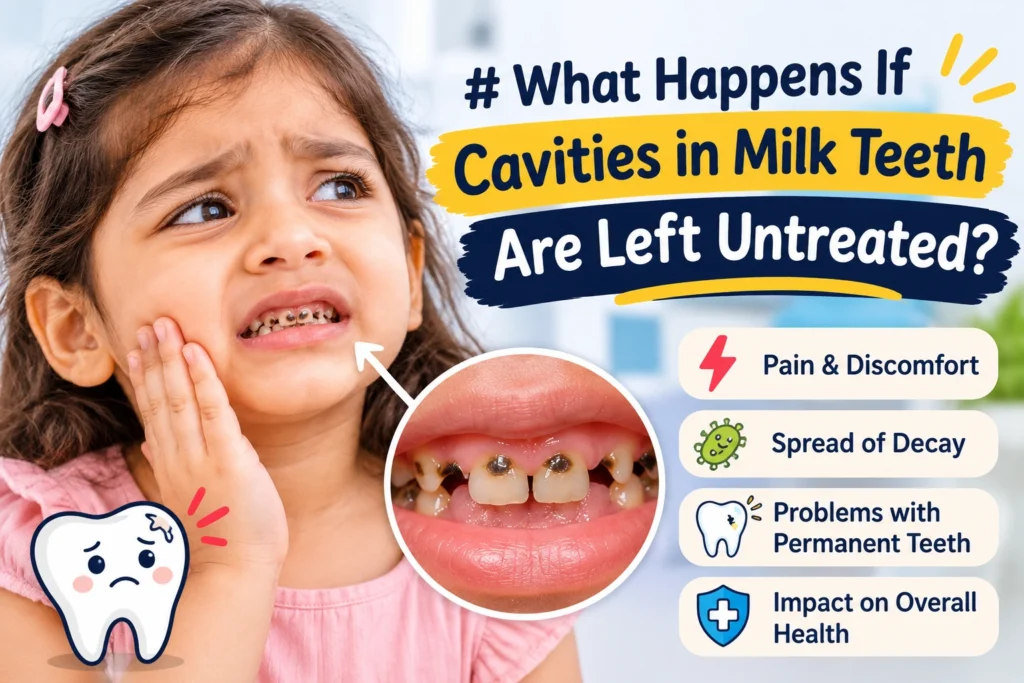
“It’s only a milk tooth. It will fall out anyway.” We hear this from parents almost every week, and it is one of the most costly dental myths for children. A cavity in a baby tooth does not stay small, and it does not disappear when the tooth is eventually shed. Left untreated, a cavity in a milk tooth can lead to pain, infection, damage to the adult tooth underneath, crowding, and much more complex treatment later.
Quick Answer
If a cavity in a milk tooth is not treated, it grows deeper through the enamel into the nerve, causing toothache, abscess (infection), swelling, trouble eating and sleeping. The infection can harm the developing permanent tooth, and losing the tooth early can cause crowding and bite problems. Early cavities are simple to fix, so visit a pediatric dentist as soon as you notice a spot or your child complains of pain.
Why Milk Teeth Cavities Get Worse So Quickly
Baby teeth have thinner enamel and a larger nerve chamber compared with adult teeth. This means decay travels from the surface to the nerve much faster, sometimes in a few months. A tiny brown or white spot today can turn into a deep cavity before your child’s next routine check-up.
Stage by Stage: What Happens When a Milk Tooth Cavity Is Ignored
| Stage | What Is Happening | What You May Notice | Usual Treatment |
|---|---|---|---|
| 1. Early enamel decay | Enamel loses minerals | Chalky white or light brown patch; usually no pain | Fluoride, better brushing, diet changes |
| 2. Cavity in enamel and dentin | Decay breaks through enamel into softer layer | Brown or black spot or small hole; sensitivity to sweets or cold | Tooth-coloured filling |
| 3. Decay reaches the nerve | Pulp becomes inflamed or infected | Toothache, night pain, pain on chewing | Pulp therapy (child root canal) and crown |
| 4. Abscess | Infection forms at the root | Swelling, pimple-like bump on gum, fever, bad taste | Urgent care: antibiotics if needed, pulp therapy or extraction |
| 5. Tooth destroyed | Crown breaks down; only roots remain | Broken tooth, ongoing infection, difficulty eating | Extraction and often a space maintainer |
8 Problems Caused by Untreated Cavities in Baby Teeth
1. Toothache and Difficulty Eating
A deep cavity hurts, especially when chewing or with sweet, hot or cold foods. Children often cannot explain the pain. Instead, they refuse food, chew on one side, become irritable or cry at night. Poor eating over time can affect nutrition and weight gain in young children.
2. Dental Abscess and Spreading Infection
Once bacteria reach the nerve, pus can collect at the root tip, forming an abscess. Signs include a swollen gum, a pimple-like bump, facial swelling and fever. In rare but serious cases, the infection can spread to the face or neck. Facial swelling, fever or trouble opening the mouth or swallowing needs same-day professional care.
3. Damage to the Permanent Tooth Underneath
The adult tooth develops just beneath the root of the baby tooth. A long-standing infection in the milk tooth can affect it, leaving the permanent tooth with discolouration, weak or pitted enamel, or an abnormal shape (sometimes called a Turner’s tooth). It may also change the path along which the adult tooth erupts.
4. Cavities Spreading to Other Teeth
Decay is a bacterial disease. A cavity in one tooth increases the bacteria load and makes neighbouring baby teeth, and the new permanent molars, more likely to decay. The first permanent molars come in around age 6, right behind the baby molars, so decay there is a direct risk to them.
5. Early Tooth Loss and Crowding
Baby teeth hold space for the permanent teeth. If a milk tooth is lost too early because of decay, nearby teeth drift into the gap. The adult tooth may then come out crooked, blocked or impacted, increasing the chances your child needs braces later.
6. Speech and Chewing Problems
Missing or badly broken front teeth can affect how some sounds are pronounced. Painful or missing back teeth make it hard to chew properly.
7. Poor Sleep, School Absence and Low Confidence
Dental pain is a common reason children miss school, struggle to concentrate and sleep badly. Visible black or broken front teeth can also make a child shy about smiling. See also our guide on why a child’s teeth turn black.
8. More Complex, Stressful and Costly Treatment
A small cavity might need only a simple filling in one short visit. A neglected one may need pulp therapy, a crown, an extraction, or treatment under sedation. Emergency treatment of a painful, swollen tooth is also the experience most likely to create lasting fear of the dentist.
“But Baby Teeth Fall Out Anyway, Right?”
Yes, but not as early as many parents think. Front teeth usually fall out around ages 6 to 8, while baby molars stay until about 10 to 12 years. That is a long time to live with a decayed tooth. Until it is shed naturally, the tooth must stay healthy, comfortable and functional, and it must protect the space for the adult tooth.
Warning Signs Your Child Has a Cavity in a Milk Tooth
- White, brown or black spots, lines or holes on a tooth
- Complaints of pain with sweets, cold drinks or chewing
- Food repeatedly stuck between teeth
- Bad breath that doesn’t go away with brushing
- Refusing food or chewing on one side only
- Swollen or red gums, or a pimple-like bump on the gum
- Waking at night crying, or unusual irritability
Pain is a late sign. Many cavities are painless at first, which is why regular check-ups every six months matter.
How Are Cavities in Milk Teeth Treated?
- Fluoride treatment: can strengthen enamel and stop very early decay from progressing. See our fluoride treatment for kids.
- Tooth-coloured fillings: remove the decay and restore the tooth. Learn about teeth fillings for children.
- Pulp therapy (child root canal): cleans and treats an infected nerve so the baby tooth can be saved. See root canal treatment for children.
- Dental crowns: protect teeth with large cavities or after pulp therapy. See dental crowns for children.
- Extraction with a space maintainer: when a tooth cannot be saved, we remove it gently and may place a small appliance to hold space. See baby tooth extraction.
- Sedation options: for very young or anxious children, when clinically appropriate. See sedation dentistry for kids.
The best treatment depends on how deep the cavity is, your child’s age, and how cooperative they are. We will explain the options in simple words and choose the least invasive approach that works.
How to Prevent Cavities in Milk Teeth
- Brush twice daily with fluoride toothpaste: a rice-grain smear for under 3 years, a pea-sized amount for ages 3 to 6. Supervise brushing until about 7 to 8 years.
- Never let your child sleep with a bottle of milk, juice or sweet drinks. Clean the gums and teeth after the last feed.
- Limit sugary and sticky snacks, and keep sweets to mealtimes instead of grazing through the day.
- Start dental visits by the first birthday and then every six months.
- Consider sealants for deep grooves on back teeth. See dental sealants for children.
- Avoid sharing spoons and cleaning a pacifier with your mouth, as decay-causing bacteria can pass from adults to babies.
When Is It a Dental Emergency?
Go to a pediatric dentist the same day for facial swelling, fever with tooth pain, a pimple-like bump on the gum, or severe pain that stops your child eating or sleeping. Read more about pediatric dental emergencies or call 0120-4225557. If swelling is spreading or your child has difficulty breathing or swallowing, go to the nearest hospital emergency department.
Child Dentist in Indirapuram for Milk Teeth Cavities
At Renaissance Child Dental Centre, Dr. Anamika Jain, a postgraduate-trained pediatric dentist and gold medalist from King George’s Medical University (KGMU), Lucknow, with hospital experience at Ram Manohar Lohia Hospital, New Delhi, treats cavities in baby teeth using gentle, child-friendly techniques. Families visit us from Indirapuram, Vaishali, Vasundhara, Ghaziabad, Noida and across Delhi NCR. Start with our pediatric dental consultation and prevention programme.
Book Your Child’s Dental Check-Up
Child Dentist Indirapuram (Renaissance Child Dental Centre)
64–66 LGF, Gate No. 2, Jaipuria Mall, Ahinsa Khand II, Indirapuram, Ghaziabad, Uttar Pradesh 201014
Phone: 0120-4225557
Email: info@renaissanceclinicindia.com
Frequently Asked Questions
Do cavities in milk teeth need to be filled?
Yes. Baby teeth help with chewing, speech and keeping space for adult teeth, and an untreated cavity can cause pain and infection. Treatment is usually simpler the earlier it is done.
Can a cavity in a baby tooth go away on its own?
No. A true cavity (a hole in the tooth) does not heal itself. Very early white-spot decay can sometimes be stopped with fluoride and better brushing, but only a dentist can tell which stage it is.
At what age do milk teeth fall out?
Front teeth usually fall out between about 6 and 8 years, while baby canines and molars may stay until 10 to 12 years. That is why a decayed baby molar should not be left untreated.
Can an infected baby tooth damage the permanent tooth?
Yes. The permanent tooth forms right under the baby tooth, and long-standing infection can cause discolouration, weak enamel or changes in how the adult tooth comes in.
Is it safe to leave a cavity until the tooth falls out?
Not usually. The cavity can grow, cause pain or abscess, and spread to nearby teeth. A dentist can advise if a tooth is close to falling out naturally and whether monitoring is safe.
What happens if a baby tooth is extracted too early?
Neighbouring teeth can drift into the gap, leaving less room for the adult tooth. A space maintainer can help keep the space open until the permanent tooth is ready.
How can I tell if my child has a toothache?
Look for refusing food, chewing on one side, crying at night, a swollen cheek or gum, or sensitivity to cold and sweets. Young children often show pain through mood and eating changes instead of words.
About the author: Dr. Anamika Jain is a pediatric dentist in Indirapuram, Ghaziabad. She completed her postgraduate dental degree at King George’s Medical University (KGMU), Lucknow, where she was a gold medalist, and previously worked at Ram Manohar Lohia Hospital, New Delhi.