
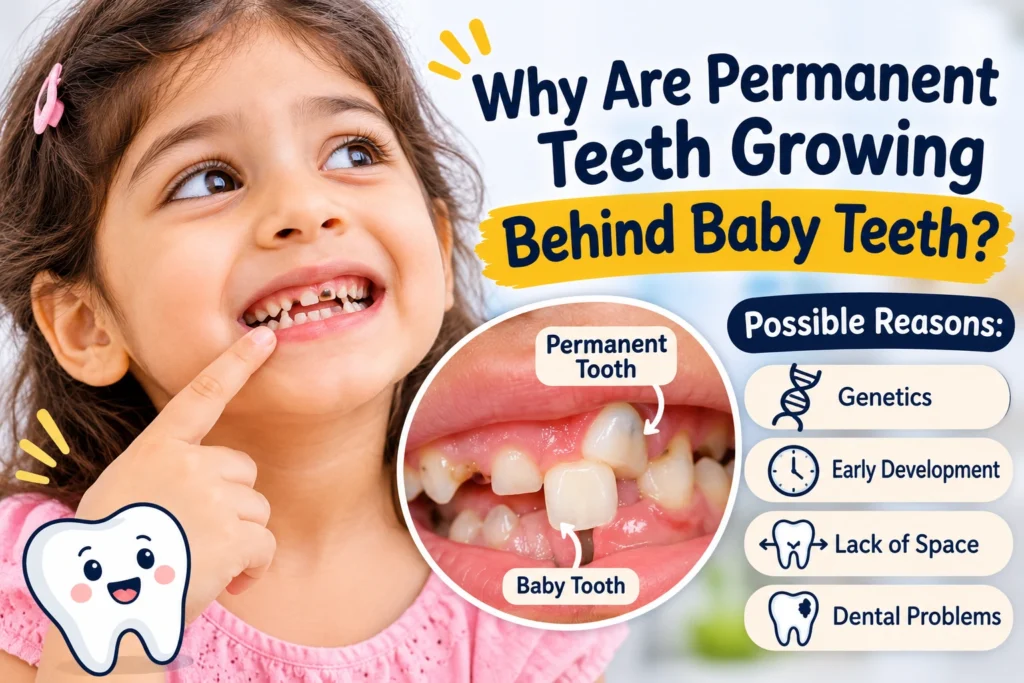
One morning you look into your child’s mouth and see a brand-new, bigger tooth coming in behind a baby tooth that hasn’t fallen out. It looks like a double row of teeth, and many parents call it “shark teeth.” It can be alarming, but it is very common, especially in the lower front teeth around age 6 to 7, and it often fixes itself. Sometimes, though, the baby tooth needs to be removed by a dentist. This guide explains why it happens, what is normal, and when to act.
Quick Answer
Permanent teeth grow behind baby teeth when the baby tooth’s root has not dissolved enough for it to become loose and fall out, so the adult tooth takes the easiest path, which is often behind (towards the tongue). The most common cause is limited space in the jaw. If the baby tooth is not loose, or hasn’t fallen out within about 2 to 3 months of the adult tooth appearing, see a pediatric dentist.
What Are “Shark Teeth” in Children?
“Shark teeth” is the popular name for a permanent tooth that erupts behind (or occasionally in front of) a baby tooth, so two rows of teeth are visible. It most often affects the lower front teeth (incisors), but can also happen with upper front teeth, canines and molars. Normally the adult tooth sits directly under the baby tooth and pushes it out as it rises. Shark teeth appear when the adult tooth is pushed off that usual path.
Why Do Permanent Teeth Come in Behind Baby Teeth?
1. The Baby Tooth Is Still Firmly Attached
A permanent tooth presses on the root of the baby tooth and slowly dissolves it. This is what makes the milk tooth loose. If the root hasn’t dissolved enough, the baby tooth stays in place, and the adult tooth erupts in the space beside it, usually on the tongue side.
2. Not Enough Space in the Jaw
Permanent front teeth are much wider than baby teeth. If your child’s jaw is small or the teeth are crowded, the adult tooth does not have room to come in straight. Crowding is the most common reason for shark teeth in the lower front teeth.
3. The Adult Tooth Grows at an Unusual Angle
Sometimes the tooth bud forms slightly out of position, or its eruption path is tilted. This is called ectopic eruption. The tooth emerges in the wrong place and may press on neighbouring teeth.
4. Delayed Root Dissolving (Retained Baby Teeth)
In some children the baby tooth’s root dissolves more slowly. Previous injury, infection or a deeply decayed baby tooth can also change how the root breaks down and delay shedding. In rare cases, a baby tooth becomes fused to the jawbone (ankylosis) and stays low and fixed in position.
5. Extra or Missing Teeth, Cysts and Other Rare Causes
An extra tooth (supernumerary tooth), or a growth blocking the eruption path, can push the permanent tooth out of line. A dental X-ray helps rule these out when the pattern looks unusual.
Normal Age Chart: When Do Baby Teeth Fall Out and Adult Teeth Come In?
These ages are averages. Normal timing varies by several months, and girls often get their teeth slightly earlier than boys.
| Tooth | Permanent Tooth Appears (approx.) |
|---|---|
| First permanent molars (behind all baby teeth) | 6 to 7 years |
| Lower central incisors | 6 to 7 years |
| Upper central incisors | 7 to 8 years |
| Lower lateral incisors | 7 to 8 years |
| Upper lateral incisors | 8 to 9 years |
| Canines (eye teeth) | 9 to 12 years |
| Premolars | 10 to 12 years |
| Second permanent molars | 11 to 13 years |
Is It Normal? When to Wait and When to See a Dentist
Usually safe to watch for a short time
- The baby tooth is already loose and wiggling.
- The adult tooth has only just started to appear.
- Your child feels no pain and the gums look healthy.
In many cases, the tongue’s natural pressure moves the new tooth forward into place after the baby tooth falls out. Encourage your child to wiggle the loose tooth gently with a clean finger or tongue.
See a pediatric dentist if:
- The baby tooth is not loose, or is still in place after 2 to 3 months of the adult tooth showing.
- The adult tooth is growing behind an upper tooth, or behind a baby tooth other than the lower front teeth.
- The new tooth looks twisted, crowded or is pushing other teeth, or your child’s bite feels off.
- There is pain, swelling, a pimple-like bump on the gum, or bleeding gums.
- The baby tooth is decayed or broken.
- Your child is over 8 years old and still has many baby front teeth with no adult teeth coming.
Pain with swelling, or fever, needs same-day care. See our page on pediatric dental emergencies.
What Happens If You Leave It Untreated?
If the baby tooth stays and the adult tooth remains out of place, your child may face:
- Crowding and crooked teeth because there’s no room to settle.
- Trapped food and plaque between two rows of teeth, which can lead to gum inflammation and cavities. Learn what happens when cavities in milk teeth are left untreated.
- Gum recession on the adult tooth if it sits too far forward or backward.
- Bite problems such as a crossbite or crowding that may need braces later.
- Impacted or displaced teeth in more complex cases.
How Do Pediatric Dentists Treat Permanent Teeth Growing Behind Baby Teeth?
Step 1: Examination and X-ray
The dentist checks how loose the baby tooth is, the position of the adult tooth, and the available space. A small dental X-ray may be taken to see the root, the tooth bud, and rule out extra teeth or other causes.
Step 2: Wait and Watch
If the baby tooth is loose and the adult tooth is not blocked, the dentist may simply ask you to monitor and return in a few weeks.
Step 3: Baby Tooth Extraction
If the baby tooth is not coming out, the dentist can remove it gently, using numbing gel or local anaesthesia, so the adult tooth can move into position. The procedure is quick and, for most children, comfortable. See our gentle baby tooth extraction service. For anxious children, sedation options may be considered.
Step 4: Monitoring Alignment
After extraction, the adult tooth usually shifts forward on its own within a few weeks. If crowding remains, the dentist will advise on teeth alignment treatment for kids and the best timing for braces or clear aligners. Early assessment does not always mean early braces. Sometimes just guiding growth and monitoring is enough.
Can I Pull My Child’s Baby Tooth at Home?
If the tooth is very loose (wiggling freely and barely attached), your child can wiggle it out with clean hands, or you can use clean gauze. Do not force or pull a firm tooth. A tooth that is still firmly attached has a long root. Pulling it can break the root, cause bleeding and pain, and leave an infection risk. A dentist can remove it in minutes safely.
How to Look After Teeth During the Mixed Dentition Stage
- Brush carefully behind the new teeth with a soft brush and fluoride toothpaste, twice a day. Plaque loves the gap between two rows.
- Don’t skip the baby teeth. A decayed baby tooth can delay shedding and harm the adult tooth. See teeth fillings for children.
- Protect new molars with dental sealants and fluoride treatment.
- Visit a pediatric dentist every six months during ages 6 to 12, when the mouth changes fastest.
- Don’t panic about gaps or crooked-looking new teeth. Adult front teeth often look uneven at first and settle as the other teeth come in.
Child Dentist in Indirapuram for Shark Teeth and Mixed Dentition Care
At Renaissance Child Dental Centre, Dr. Anamika Jain, a postgraduate-trained pediatric dentist and gold medalist from King George’s Medical University (KGMU), Lucknow, with hospital experience at Ram Manohar Lohia Hospital, New Delhi, guides children through the change from baby to adult teeth. We use gentle, child-friendly techniques and explain every step to parents. Families visit us from Indirapuram, Vaishali, Vasundhara, Ghaziabad, Noida and across Delhi NCR. Learn more about our pediatric dental consultation and prevention programme.
Book Your Child’s Dental Check-Up
Child Dentist Indirapuram (Renaissance Child Dental Centre)
64–66 LGF, Gate No. 2, Jaipuria Mall, Ahinsa Khand II, Indirapuram, Ghaziabad, Uttar Pradesh 201014
Phone: 0120-4225557
Email: info@renaissanceclinicindia.com
Frequently Asked Questions
Why is my child’s adult tooth growing behind the baby tooth?
Usually because the baby tooth’s root hasn’t dissolved enough for it to loosen, or because the jaw is too small for the wider adult tooth. The adult tooth then takes the easiest path, often behind the baby tooth.
Are shark teeth normal in children?
Yes, they are common, especially in the lower front teeth at around 6 to 7 years. Many cases correct themselves once the baby tooth falls out, but a dentist should check if it doesn’t.
How long can a baby tooth stay after the adult tooth comes in?
Ideally it falls out within a few weeks. If it is still firmly in place after about 2 to 3 months, book a dental visit.
Will the permanent tooth move forward by itself?
Often yes. Once the baby tooth is out, tongue pressure usually moves the adult tooth forward into the arch. If there isn’t enough room, it may stay crooked and need orthodontic guidance.
Is it painful to remove a baby tooth that won’t fall out?
Not usually. Dentists use numbing gel or local anaesthesia, and the extraction of a baby tooth is quick. Children typically feel pressure but no sharp pain.
Does my child need braces if teeth grow behind baby teeth?
Not always. Many children only need monitoring or simple extraction. Braces may be advised later if crowding or bite problems remain once most permanent teeth are in.
What if the permanent tooth grows behind an upper baby tooth?
Upper teeth coming in behind baby teeth, and canines or molars in odd positions, are less likely to correct themselves, so have your child checked promptly by a pediatric dentist.
About the author: Dr. Anamika Jain is a pediatric dentist in Indirapuram, Ghaziabad. She completed her postgraduate dental degree at King George’s Medical University (KGMU), Lucknow, where she was a gold medalist, and previously worked at Ram Manohar Lohia Hospital, New Delhi.